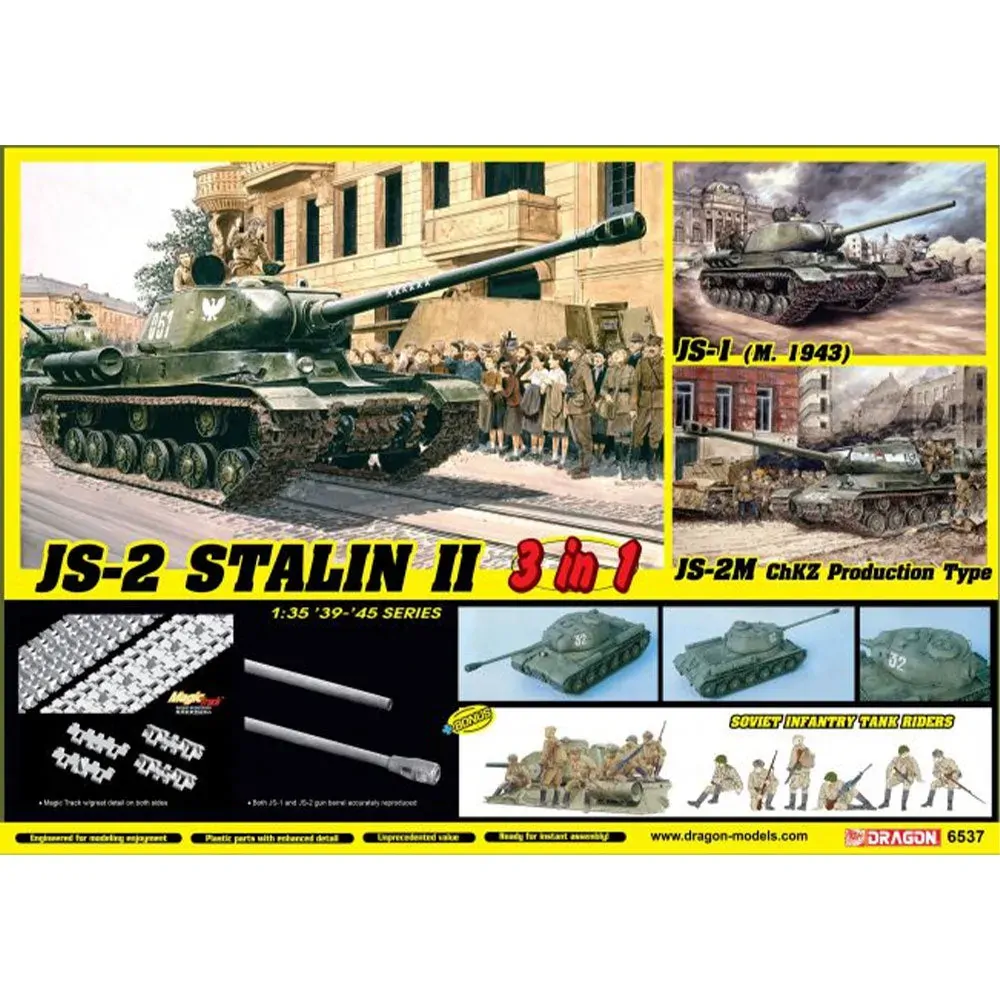
DRAGON 6537 JS-2 STALIN 3 IN 1 + SOVIET INFANTRY TANK RIDERS 1/35 SCALE PLASTIC MODEL KIT
SKU code: 089195865373
The IS-2 is a Soviet heavy tank from the Second World War. The first prototypes of this vehicle were built in 1943, and it entered service in the same year. 3400-3600 vehicles of this type were manufactured in the course of production. The combat weight of the tank was up to 46 tons. The drive was provided by a single W-2-IS diesel engine with a power of up to 520 HP. The basic armament consisted of the 122 mm D-25T gun and 3-4 machine guns: 1 12.7 mm DSzK rifle and 2-3 7.62 mm DT rifles.
The IS-2 was developed as a development of the IS-1 tank, and the main difference between the two turrets was the use of a much more powerful armament in the IS-2, i.e. the 122mm gun. It allowed the IS-2 to engage in a fairly equal fight with the German PzKpfw vehicles. V and VI, as well as to effectively support the attack of own infantry. Already in the course of World War II, the basic version of the IS-2 was modernized, bearing the designation IS-2M, which was characterized by the use of, among others: a semi-automatic wedge lock, improving the rate of fire, as well as changing the front armor plates on the hull. The IS-2 tanks proved to be very useful heavy tanks with high combat value in the period 1943-1945. It is worth adding that they were formed almost exclusively into separate Guard heavy tank regiments.
In the 1920s and - especially - in the 1930s, the Red Army underwent a rapid development in terms of increasing its posts, as well as increasing saturation with technical weapons, primarily armored weapons. Still, the infantry was the primary and numerically largest element of the Red Army. The intensive quantitative development of this type of weapon began at the turn of 1929/1930. In 1939, even before the aggression against Poland, the Soviet infantry was formed into 173 divisions (so-called rifle divisions), most of which were grouped in 43 corps. It is worth adding that after the September campaign in 1939, this number increased even more. The Soviet rifle division in 1941 consisted of three rifle regiments (three battalions each), an artillery regiment, after an anti-tank and anti-aircraft artillery division, as well as reconnaissance and communication battalions. In total, it numbered about 14,500 people. However, by 1945 this position underwent significant changes, leading to a division of approximately 11,500-12,000 people, consisting of three infantry regiments, an artillery brigade consisting of three regiments, a self-propelled artillery squadron and many support units, including anti-tank, anti-aircraft weapons or communications. The saturation of infantry units with machine weapons has also increased significantly - for example with the submachine guns APsZ 41, and later APsZ 43.
| SKU | 089195865373 |
| Brand | DRAGON |
| Shipping Weight | 0.8000kg |
| Shipping Width | 0.025m |
| Shipping Height | 0.008m |
| Shipping Length | 0.038m |
| Shipping Cubic | 0.000008000m3 |
| Type | HOBBIES-PLASTIC KITS |
Be The First To Review This Product!
Help other Sik Hobbies users shop smarter by writing reviews for products you have purchased.